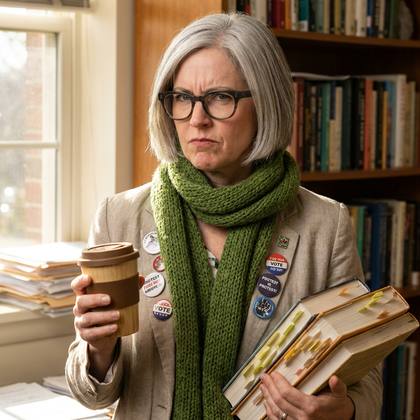
 By Dr. Penelope Ashworth-Vane
Colleagues, comrades, and the three undergraduates who read this column for extra credit: I write to you from my office in a state the literature1 describes as “post-electoral euphoria,” a condition previously believed to be extinct in South Carolina.
On November 3, the voters of this state did something the academy had, frankly, given up on. They sent a Democrat to the United States Senate for the first time in 28 years. Dr. Annie Andrews, a pediatrician, won the seat with 51 percent of the vote. On the same night, Democrats flipped 10 seats in the state House and broke the Republican supermajority. I have not seen this much blue in the Upstate since the dining hall served the blueberry compote I later filed a formal complaint about.2
I want to be measured. I am, after all, a scholar. So allow me to say, with appropriate academic restraint: this is the most important event in human history since the invention of the footnote.
Naturally, I have questions about what it means for this university. Will Clemson finally replace its parking lots with community gardens? Will the president’s office become a cooperative? Will the football team adopt a more equitable model in which touchdowns are redistributed among all players, including those who did not score them? I have drafted a memo to the Board of Trustees on each of these points. It is 41 pages. They have not responded, which I am interpreting as consent.
Some have urged caution. They point out that a Republican, Alan Wilson, won the governor’s race by the very same margin, and that no other statewide office changed hands. To them I say: you are focusing on the parts of the map that are still red, which is exactly what someone who supports parking lots would say.
A tsunami does not ask permission. Neither, incidentally, does tenure.
My students have asked how they should celebrate. I suggested a teach-in, followed by a second teach-in about the first teach-in, followed by composting. One student asked if he could simply go to a bar downtown. I gave him a C-minus on the spot. The syllabus permits this.
I recognize that not everyone in Pickens County shares my excitement. Several of my neighbors have taken down their yard signs with what I can only describe as moving-truck energy. To them I extend my sympathy, my reading list, and a pamphlet titled “So Your State Is Turning Purple: A Workbook.”
As for me, I have requested a one-semester sabbatical to process my joy. The dean has not approved it. The dean also has a reserved parking space. I am simply noting the facts.
- Ashworth-Vane, P. (2019). “Hope as a Renewable Resource in Deep-Red Contexts.” Journal of Things That Could Happen, 4(2).
- Ashworth-Vane, P. (2024). “Compote and Coloniality: A Dining Hall Ethnography.” Self-published.